Tuesday, February 26, 2008

Broken Camera


Yesterday at the Changi airport, moments after the photo above was taken, my foot swiped the strap of my EOS 350D, sending it crashing to the tiled floor. The 50mm lens attached to it was demolished (the ribbon cable snapped), the flash diffuser on the camera itself cracked, the pentamirror cover got broken and misaligned, and the grip cover was slightly dislodged but I was able to pop it back into place.

The 50mm was destroyed but I was hopeful I could wire the two circuit boards together again with some ribbon cable; besides that lens was on its second life already because it had fallen from a shelf some months ago and I had just repaired it. I was upset because the DSLR itself got damaged but it was still taking photos; the damage seemed superficial.

What has me completely depressed is that, after I "repaired" the 50mm lens, it damaged the camera. Maybe I shorted some wires invisibly, or maybe the lens was really damaged beyond repair and re-connecting it to the camera was a really bad idea. Whatever the cause, the camera won't turn on anymore. It shut down the first time I attached the "repaired" 50mm, but came back to life a few minutes later. Now it won't turn on anymore.

The really depressing thing is, aside from these trips, I hardly used the camera (less than 6,000 shutter actuations) so it's pretty new. I hope a trip to Canon will fix it. But that has a cost. I am so not in a position to incur more costs. And all this because I thought I can fix anything.

Edit: seems there are three surface-mount fuses on the main board. Perhaps my "shorting adventure" blew one of them out. Seems reasonable. I am not going to try to repair that, even though there are instructions on the net. Once is enough. Off to Canon it goes, fuse replacement should not be too expensive. Maybe they can also replace the dented body panels. This Singapore trip has proven a lot more expensive than I thought, in unexpected ways.

Monday, February 11, 2008

More Vivitar 283 Hacking

I decided to do more mods to my Vivitar 283: first, add a 250K potentiometer in order to get variable power capability; and second, add a trigger circuit in order to bring down the 110V trigger voltage to something more manageable. I knew that the EOS 350D has a 250V trigger voltage limit, but accessories like the Cactus wireless trigger only have a 12V limit, and besides, I'd feel better with some extra circuitry between the scary high 110V of the Vivitar and my DSLR.

I got the following circuit from Sam's Electronic Flash FAQ:


Lalai and I went to Megamall to do our groceries. It's out of the way but Alexan is there. I went to Alexan and bought the parts (as well as some other stuff like an extra LM1875 and a PCB so I can do some etching).

My Alexan buying experience was fraught with upsets. First, they didn't have any 4M resistors; what they had were 4.3M. Same thing for the 5V zener: they had 5.1V instead. Third, they had no 22nF, 400V capacitors. All their ceramic capacitors were 50V only, they said. So I bought eight 0.1uF capacitors, to put in series, which should give 400V. I don't even know what's the value of eight 0.1uF capacitors in series. Forgot my EE13.

When I got home I had a nasty surprise: the girl at the counter didn't give me any 4.3M resistors or 5.1V zeners. Apparently the blindingly obvious fact that a 5V zener and a 5.1V one, or a 4M resistor and a 4.3M one, are interchangeable, is beyond the ken of Alexan sales staff.

Since I didn't check the parts, I didn't discover that some critical bits were missing until I had the flash in pieces and my soldering iron hot.

Rummaging through my parts bin, I found a couple of 1M resistors and a 15V zener. Since I had no choice, I substituted the 1M for the 4M resistors; and the 15V zener for the 5V one. I knew this would result in a 15V trigger voltage instead of the desired 5V, but 15V is much better than 110V (and presumably the Cactus can survive 15V).


The circuit is very simple, so I just soldered it together point-to-point and covered the exposed wires with heat-shrink tubing and cellophane tape. I put it inside the (now vacated) battery compartment, and rewired the hot shoe to connect to my circuit instead of directly to the flash trigger.

Verifying that trigger voltage is now much, much more manageable:


While I was at it, I also did the potentiometer variable-power mod. This allows me "infinite" gradations of power, but Alexan didn't have any log-taper potentiometers, only linear-taper (another annoyance - but I don't want to go to Raon, so I grit my teeth).

After closing up the case, the ugly tape-wrapped circuit is hidden from view:
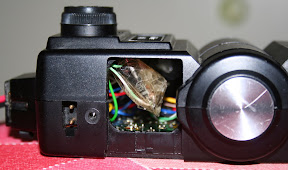


And here's another view, showing the potentiometer mod:


Great success!
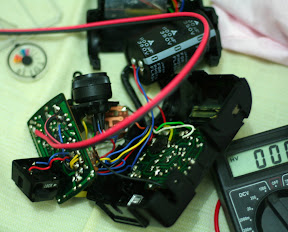
Sunday, February 10, 2008

Vivitar 283 Hacking

For some reason or another, the Vivitar 283 which I purchased on e-bay stopped working yet again. I thought it was more of the battery corrosion or something, but apparently that wasn't the case.

I first tried modding the battery compartment to run a couple wires in there. But it failed to work. I was getting pretty annoyed at having wasted $30 and the freight forwarding fee; I didn't know why the inverter wasn't working (couldn't hear the inverter whine).

Read through Sam Goldwasser's Strobe FAQ which mentioned that the obvious failure modes in flash inverters are the transformer and the chopper transistor. Now it's been a long long time since EE 25 and I don't think it's possible anyway to test a transistor in-circuit.

Anyway I was cursing my luck and had the strobe in pieces in front of me.


I neglected to note that I had left it on and it was connected to the 6V gel cell.. the outcome is obvious. My finger grazed the huge flash capacitor and I got this sensation like someone had driven a red-hot needle through my finger. Immediately realizing what was going on, I tested the voltage across the flash capacitor with my trusty 165-peso digital multimeter and guess what... 160-odd volts.

Not enough to light the "ready" indicator but enough to give me a small shock. I figured that the inverter was working, but not well enough (nominal flash capacitor voltage is 300-plus volts). So I un-soldered the original wires for the power, and soldered lamp cord directly to the switch and the collector of the chopper transistor:


I used color-coded lamp cord to avoid strobe-destroying accidents. At this point, after powering it up, I could hear the distinctive inverter whine, and the flash would fire when I pressed the test button.

When I put the 283 together, I didn't put the battery compartment in anymore (since with all my screwing around the inside of the strobe, it will never take AA batteries again).


This is OK because I don't intend to use AA batteries (I gave away my AA NiMH batteries to my brother, and I don't want to buy new ones, they're expensive at $5 each).

Here I'm testing the trigger voltage. It's around 110 volts according to my 165-peso multimeter. Well within the capabilities of the EOS 350D (which has a 250V sync voltage). That is, if I trust my $500-plus DSLR to my $4 Chinese-made multimeter.


Final result: it's got that wire dangling out which somewhat interferes with the EOS control dial, but I've got a Quantum power pack on the cheap! I don't have a charger for the 6V gel cell, but a Nokia phone charger should do (it puts out about 7V).


I'd like to think I'm "l33t" for both restoring the Vivitar 283 to good condition; and for wiring up a Quantum-alike battery pack. But the reality is I'm too poor to buy a Speedlite 420EX or something. But the Vivitar 283 will do fine.

Saturday, February 09, 2008

Aural Goodness

Lalai got this today (and is listening to Rihanna and the Pussycat Dolls.. in my opinion a lamentable use for these British boxes):

Wharfedale Diamond 9.2 in black ash.


I haven't gotten to listen to anything nuanced or vocal yet on 'em, thanks to Don't Cha and Umbrella. Anyway they haven't burned in yet, and neither has the GainClone chip amplifier I built that's providing the power.

Actually I made my GainClone a bit nicer-looking, put bigger heat sinks on the LM1875's and put the whole contraption in a black plastic case from Alexan. The halogen transformers are still "naked" though.

Two LM1875's, two heat sinks, four MUR1520 soft-recovery diodes on a piece of veroboard, and lots of wire!


I used ordinary lamp cord instead of speaker wire; and the transformers are right on top of the amplifier (theoretically contributing to power-line hum). But the whole system sounds much better than our ancient Altec Lansing ACS 45's (and it had better! I actually put those exotic MUR1520's in the power supply!)

Thursday, February 07, 2008

Vintage Camera Gear

I bought an ancient Vivitar 283 flash on e-bay. This was a professional staple in the 1960's and 1970's and is still a decent flash (GN 30) even today. It lacks any form of automation, though, and has a scary high trigger voltage which can fry modern cameras (although the EOS 350D has a 250V trigger voltage limit).

As I got it, however, there was corrosion in the battery compartment and it wouldn't power up. Following this website, I carefully took it apart so that I could clean the guts of the thing.

Look at all that corrosion on the battery terminals!


And look at the size of that flash capacitor! 1100 microfarads at 350V! pretty lethal..


After cleaning up the inside, here it is sitting on my thirty-year old Fujica ST605N M42-mount SLR:


The Fujica triggers the flash satisfactorily (I can't test with the EOS 350D because my digital voltmeter is cheap, and could be loading the trigger circuit and thus indicating a lower voltage than the actual one present). I have to build a triac-controlled safe sync circuit before I can use this on the digital Rebel.

Monday, February 04, 2008

The Pentax Super Takumar

After a day's work at the large telco, I once again went to Glorietta to wait for Lalai.

Anyway, it was the second-to-last day of Photoworld Manila and the fellow selling ancient cameras was in attendance. He had two Pentax Screw Mount lenses on sale, a 50mm f/4 Super Macro Takumar, and a 50mm f/1.8 Super Takumar normal lens.

I had a look at the f/1.8 lens, it was very weightily built, with a knurled metal focusing ring and a focusing action so smooth, you'd think it was lubricated with butter. I was really taken aback about how smooth and solid the lens felt; my East German and Russian glass seem crude by comparison.

The guy selling it, named Jun, was asking 2,800 pesos for it, or about $70. A reasonable price actually, for such a fine piece of machinery. Except I already have a 50mm f/1.8 lens, made mostly of plastic with a Canon label. But it has auto-focus. I really want an f/1.4 lens for the shallower depth of field.

Mike Johnston, in his Sunday Morning Photographer article on "his favorite lens," (the Pentax Super Takumar) explains that in the 1960's, Pentax was competing directly with Zeiss; their SMC multi-coating was as good or better than Zeiss T* coating; and the mechanics of the Pentax flagship lenses were every bit as good as Leica.

Mike writes that Pentax manufactured every 50mm f/1.4 lens at a loss, with lots of hand-fitting, precisely because it was their flagship lens and they were going up against Zeiss.

After handling that forty-year old lens today, I believe him!

Mike Johnston also rated the bokeh of the Pentax very highly; unlike almost all other manufacturers, the central cemented doublet in the Super Takumar has curved (not flat) surfaces, which gives this lens a very pleasing bokeh.

I guess I know what normal lens I want now; I can forget about the Zeiss Pancolar or the Helios-44. A 50mm f/1.4 lens on an APS-C DSLR is pretty much equivalent to a conventional 85mm portrait lens on 35mm.

Sunday, February 03, 2008

Lens Repair

A few months ago, one of our shelves gave way, and a number of valuable gadgets went plummeting six feet to the wooden floor. One of these gadgets was my Canon 50mm f/1.8 II lens. By a stroke of luck, the actual camera only feel three feet (it landed on top of our old CRT monitor).

Something got banged up inside the 50mm lens, and it would no longer auto-focus. Turning the focusing ring was hard, something was binding inside.

I found these instructions for dis-assembling the lens and fixing the insides, but my first attempt was a failure. Today, I realized that the two metal spacers referred to in the instructions, were slightly out-of-round due to the fall.

After giving the spacers some whacks with a hammer, I found that it's pretty impossible to get them completely flat -- the out-of-roundness and non-flatness of the spacers were causing some plastic tabs inside the lens to bind.

I came up with a pretty ghetto solution: using a peeling knife, I shaved bits of plastic off the tabs inside the lens barrel, this will allow the tabs to slide past the not-quite-flat metal spacers and remove the binding.

And voila! this photo was taken at the closest focusing distance.


The lettering on top of the 135mm Sonnar is pretty sharp; not bad for DIY-repaired autofocus. The lens rattles a bit more now, because I removed one of the spacers, but it seems to work. Will do fine so long as I don't drop it again..

Saturday, February 02, 2008

Putin's Revenge

I was browsing last night for ancient Russian lenses (like the Mir-1V and Jupiter-9 which I possess) and was unpleasantly surprised that prices have skyrocketed since I bought those lenses six or seven years ago.


The Jupiter-9 85mm f/2 which I got for perhaps $40 now sells for $130.


The Mir-1V 37mm f/2.8 which I got for a throwaway price of $20 now costs $70.


And the Carl Zeiss Jena 135mm f/3.5 which I got for $80 (nevermind the shipping costs and Western Union fees from the Czech Republic..) now goes for around $120 on e-bay. This is the late black multi-coated version, not the earlier, lesser-performing but more desirable "zebra" version.

Now I'm sure these price appreciations have much to do with the weakening of the Almighty Dollar, but I suspect a large part of it is also due to Putin's Revenge. Russia is no longer the Boris "old boozer" Yeltsin economic basket case it was in 2000. Vladimir's Russia is an economic powerhouse bulging with oil and gas.

And so the manufactured-in-Lytkarino Jupiter-9 is no longer the piece of (relative) trash it once was derided to be. It's still way cheaper than the Canon 85mm f/1.8 (as I was reminded of on my visit to Photoworld Manila) though. Hopefully my split-image focusing screen (it's not Haoda or Katz Eye, but rather a cheap Shanghai knockoff, so my hopes aren't that high) will enable me to focus accurately and knock the socks off the Photoworld Manila fan boys with their long, slow kit lenses.

For the photographically inclined, I took the photos of my old lenses with a 55mm f/2.2 Fujinon normal lens (an M42/Pentax Screw Mount lens) at f/4.0 indicated. I used a Vivitar 20mm M42 extension tube to decrease the close-focusing distance, and a generic Russian M42 to EOS mechanical adapter.

Macro focusing is iffy at best, even more so with the peephole finders of consumer DSLR's, so I focused by moving the whole camera back and forth, then fired off twenty or so shots. Odds will be that you'll get a handful of them sharp, which proved to be the case.

Friday, February 01, 2008

Photoworld Manila 2008

I was at Glorietta today, the first day of Photoworld Manila 2008.

As usual, there was the gamut of drool-worthy gear. Gazing at all that gear is far less exciting, and actually, far more depressing than usual, now that I can actually afford most of the gear on display.

That's what two days of listening to the Rich Dad, Poor Dad audio-book while driving to work did to me. It's depressing. All that gear acquisition -- that purchasing of liabilities -- has put Lalai and me firmly in the "slave to money" middle class. We should've been buying assets! according to Robert Kiyosaki.

On another topic.. good thing I did a Google for Bob. This guy, John T. Reed, has a lot of bad things to say about Bob, and actually took the time to track down Bob's various claims.

It seems that

  • Bob isn't as rich as he claims to be
  • Bob isn't as smart as he claims to be
  • Bob is dishonest about many many things
  • Bob gives bad advice


And to think I was contemplating a really, really major investment decision because of those two days' worth of driving with Bob.